
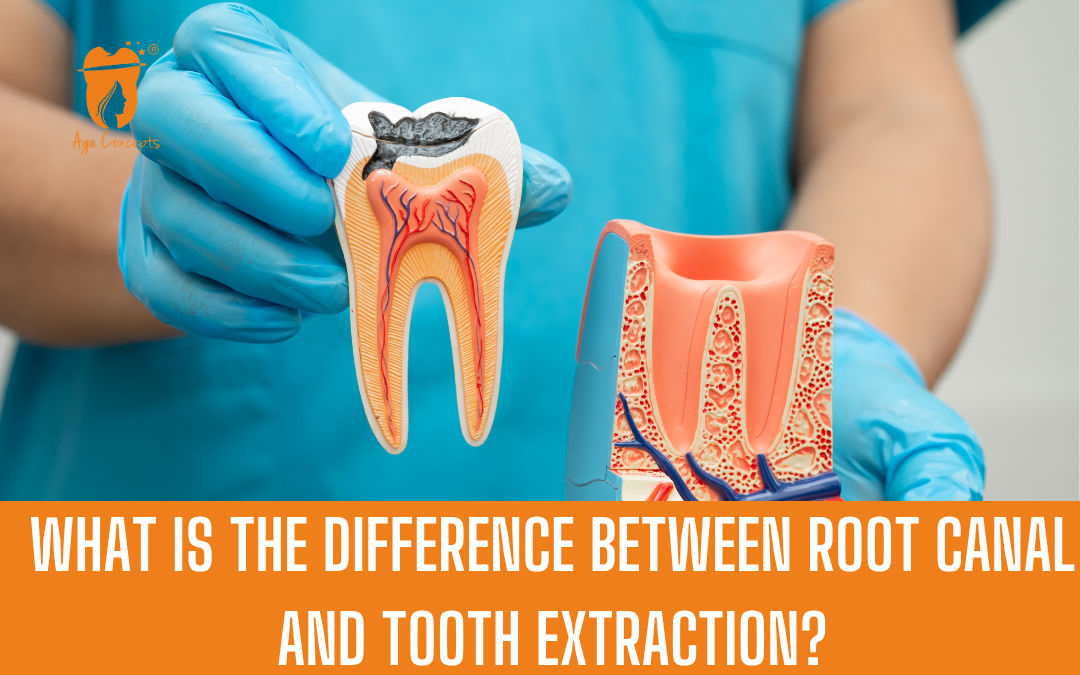
A root canal saves the tooth, an extraction removes it. The root canal cleans out the infected pulp inside, then seals and usually crowns whatever is left, so your own tooth stays where it was. Pull the tooth instead and you’re left with a gap that has to be filled to stop the rest from drifting. As a rule of thumb, dentists hold onto a tooth whenever there’s enough sound structure left to work with.
According to Dr. Swapnil Bhagwat at Age Concepts, a dental clinic in seawoods, “even a tooth that’s been through a root canal tends to serve you better than the gap you’d be left with, so pulling it really should be the last option, not the first one on the table.”
How do root canal and extraction differ?
Two opposite approaches really, one trying to keep the tooth, the other giving up on it.
- The aim: with a root canal the goal is to rescue the tooth by clearing the infection from inside it, whereas an extraction concedes the tooth and lifts it out whole.
- What’s left: the natural root carries on holding place in your jaw after a root canal, while extraction leaves behind an empty socket where the tooth used to sit.
- After: a saved tooth gets crowned and chews much like before, but an extracted one means choosing between an implant, a bridge, or a denture to close the space.
- The odds: ten years on, treated teeth survive at roughly 97%, which is why saving usually wins out over replacing whenever the option is genuinely there.
When there’s enough healthy tooth left to build on, a root canal tends to be the gentler, more conservative path.
When is tooth extraction the better option?
Some teeth genuinely are past saving, and pulling them is the sensible call rather than a defeat.
- Too damaged: a tooth cracked far below the gumline, or decayed past the point any crown could grip, often can’t hold restoration, so removing it is the only honest answer.
- Severe infection: if the bone around a tooth has melted away from long-standing infection, the tooth itself usually isn’t worth the trouble of trying to keep.
- Crowding or impaction: stuck or shoving teeth, wisdom teeth above all, mostly get taken out rather than treated, since saving them rarely improves anything.
- Repeated failures: a tooth whose root canal has already failed once or twice eventually reaches the limit of what’s worth attempting on it.
Impaction is the cleanest example of when removal really is the answer, and it’s worth keeping in mind when you’re deciding whether a wisdom tooth needs to come out at all.
Why Choose Dr. Swapnil Bhagwat to know the difference between Root Canal and Tooth Extraction?
Dr. Swapnil Bhagwat brings over 15 years of clinical experience and a Gold Medal from MARDC, Pune, and his instinct on these cases leans firmly toward keeping the natural tooth wherever it’s salvageable rather than reaching straight for the forceps.
Each tooth here is judged on how much sound structure it still has left, so a root canal is offered when there’s a tooth worth saving and extraction is held back for the cases where holding on would do more harm than letting go.
Call +91 9860782782 to book your consultation.
Schedule a consultation with Age Concepts to know how Root Canal and Tooth Extraction Differ?
FAQ's
1. Is a root canal better than an extraction?
Usually yes, since saving the natural tooth preserves your bite and jawbone.
2. Is a root canal painful compared to extraction?
Both are done under anaesthesia, so neither should hurt during treatment.
3. What happens if I just extract the tooth?
The gap left behind needs an implant, bridge, or denture to avoid problems.
4. Can every tooth be saved with a root canal?
No, badly broken or severely infected teeth sometimes have to be extracted.
Disclaimer
This content is for general information only and is not a substitute for professional dental advice, diagnosis, or treatment.